
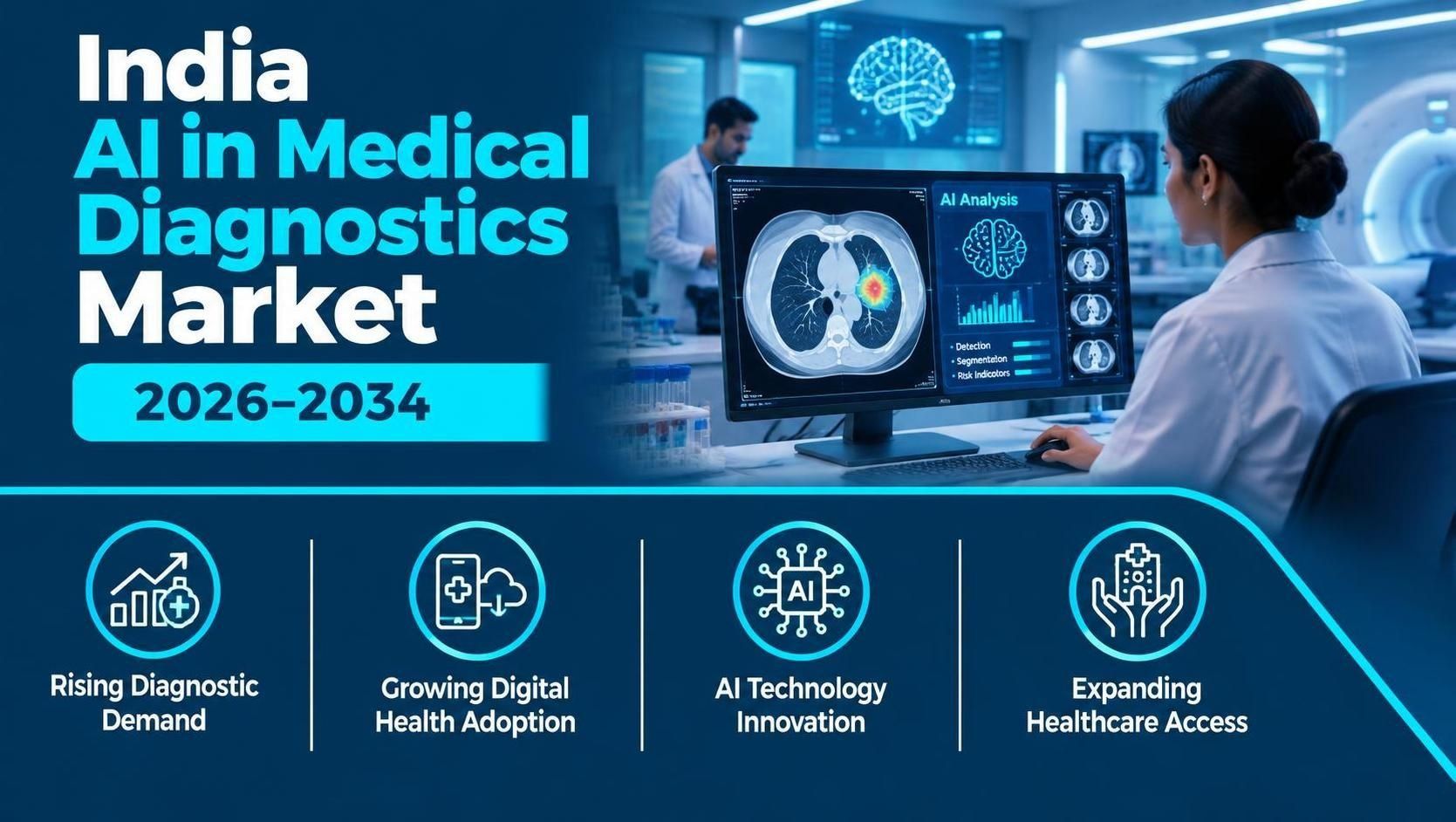
India AI in Medical Diagnostics Market-At-A-Glance
- Market Size (2025): USD 69.8 Million
- Forecast Market Size (2034): USD 584.8 Million
- CAGR (2026-2034): 25.83%
- Components Covered: Software, Hardware, Services
- Applications Covered: In Vivo Diagnostics, In Vitro Diagnostics
- End Users Covered: Hospitals, Diagnostics Imaging Centers, Diagnostic Laboratories, Others
- Regions Covered: North India, South India, East India, West India
Why Is the India AI in Medical Diagnostics Market Growing?
- Adoption of Digital Health Technologies:
Electronic health records, remote patient monitoring and telemedicine generate large volumes of patient data that AI can turn into risk insights and early warnings. The India AI in medical diagnostics market share is expanding as healthcare providers rely on AI tools to improve diagnostic accuracy and speed.
- Rising Demand for Early Disease Detection:
AI algorithms examine medical images, genetic data and clinical records to detect patterns early, which is valuable for cancer, cardiovascular and neurological conditions. In December 2024, NURA, a diagnostic initiative from Fujifilm Healthcare and Dr. Kutty's Healthcare, prepared to launch an AI-focused health screening center in Calicut, designed to screen as many as 50 individuals daily.
- Make in India Medical Technology Manufacturing:
In March 2025, Wipro GE Healthcare launched the Versana Premier R3, an AI-oriented ultrasound solution produced at its PLI facility in Bengaluru. AI-based automation helps streamline workflows and supports more tailored, preventive care.
- Skills and Training Collaboration:
In February 2025, Virohan, a healthcare EdTech platform, teamed up with Mahajan Imaging & Labs to give students hands-on experience with AI-focused imaging and diagnostic tools, helping build the workforce needed to run these systems.
Evaluate Market Opportunity with the Business Sample Report
What Are the Key Trends Shaping the India AI in Medical Diagnostics Market?
- AI-Assisted Radiology and Imaging:
AI-based imaging systems identify subtle abnormalities that traditional scans might overlook, enabling faster and more precise clinical decisions. This is encouraging providers to invest in specialized, AI-equipped diagnostic centers and expand access to better services.
- Wearables and Remote Monitoring:
AI-oriented wearable devices track vital signs and flag irregularities that may need medical attention, extending diagnostics beyond clinic walls and into daily life.
- Predictive and Personalized Care Platforms:
In December 2024, Aciana unveiled Ciana, an integrated healthcare platform using genetic insights and AI-oriented analytics, including facial scans that assess 25 essential health metrics within 30 seconds. Such platforms aim to fill delivery gaps with personalized, predictive care.
Government Support Driving Market Expansion
Ayushman Bharat Digital Mission (ABDM):
- National digital health ecosystem with health IDs and interoperable records
- Creates the structured data foundation that AI diagnostics depend on
- Supports telemedicine integration and digital transformation in healthcare
Make in India and PLI Scheme for Medical Devices:
- Encourages domestic manufacturing of advanced medical technology
- Supports AI-enabled imaging solutions built at Indian facilities
- Improves supply availability and long-term cost competitiveness
IndiaAI Mission:
- National effort to strengthen computing capacity, datasets and trusted AI development
- Supports startups building AI-based healthcare tools
- Promotes responsible and safe AI adoption
National Telemedicine and Ethical Guidance:
- e-Sanjeevani telemedicine services expand access to remote consultations
- ICMR ethical guidelines for AI in biomedical research and healthcare promote responsible use of AI in clinical settings
Explore the Full Report with Charts, Table of Contents, and List of Figures
Segment Insights
Component Insights:
- Software
- Hardware
- Services
IMARC Group's analysis evaluates how software, hardware and services each contribute to adoption across diagnostic workflows.
Application Insights:
- In Vivo Diagnostics
- In Vitro Diagnostics
The report compares AI adoption across imaging-led in vivo and sample-based in vitro diagnostics.
End User Insights:
- Hospitals
- Diagnostics Imaging Centers
- Diagnostic Laboratories
- Others
End-user analysis shows where AI investment is concentrated across the diagnostic care pathway.
Regional Insights:
- North India
- South India
- East India
- West India
Regional analysis tracks adoption patterns across the four major zones of India.
Competitive Landscape
The India AI in medical diagnostics market is led by a mix of global medical technology companies, domestic diagnostic chains and fast-moving health tech startups. Participants named in recent activity include Wipro GE Healthcare, Fujifilm Healthcare, Dr. Kutty's Healthcare, Aciana and Mahajan Imaging & Labs.
Competition is shaped by data access, clinical validation, workflow integration and Make in India manufacturing. Companies that combine reliable algorithms with strong clinical partnerships and scalable platforms are best positioned to win.
Key Opportunities for Businesses and Investors
High-Growth Areas:
- AI-enabled radiology and imaging solutions for hospitals and imaging centers
- AI-powered screening centers focused on early detection of cancer, cardiovascular and neurological conditions
- Wearable-linked remote monitoring and virtual consultation tools
- Domestic manufacturing of AI-enabled diagnostic hardware
Strategic Opportunities:
- Partnerships between technology companies and diagnostic chains to scale screening programs
- Education and training collaborations that build an AI-ready diagnostic workforce
- Integration of AI tools with national digital health infrastructure for interoperable, data-driven care
Discuss Your Requirements With an Analyst and Get Your Customized Market Report
Frequently Asked Questions (FAQ)
- How big is the AI in medical diagnostics market in India?
The India AI in medical diagnostics market size reached USD 69.8 Million in 2025.
- What is the projected growth rate?
The market is expected to grow at a CAGR of 25.83% during 2026-2034, reaching USD 584.8 Million by 2034.
- What are the key growth drivers?
Key drivers include rising healthcare provider reliance on AI tools, digital transformation momentum and growing investment in diagnostic accuracy and speed.
- Which segments does the report cover?
The report covers component, application, end user and region.
- What trends are shaping the market?
Key trends include early disease detection demand, AI-powered digital health platforms, wearable device adoption, telemedicine integration and personalized, precision-driven care.
Conclusion
India's AI in medical diagnostics market is set for rapid growth through 2034, backed by digital health transformation, domestic manufacturing and a strong push toward earlier, more accurate diagnosis.
Organizations that invest in clinically validated AI tools, strong data partnerships and workforce training will capture the largest share of this transformative healthcare opportunity.
Source: IMARC Group