
India Food Enzymes Market Outlook
The market is expanding as the country’s food processing industry scales up and consumers move toward processed, packaged, and convenience foods. Enzymes now sit at the center of this shift, helping manufacturers improve texture, flavor, and shelf life while replacing synthetic additives and chemical processing aids.
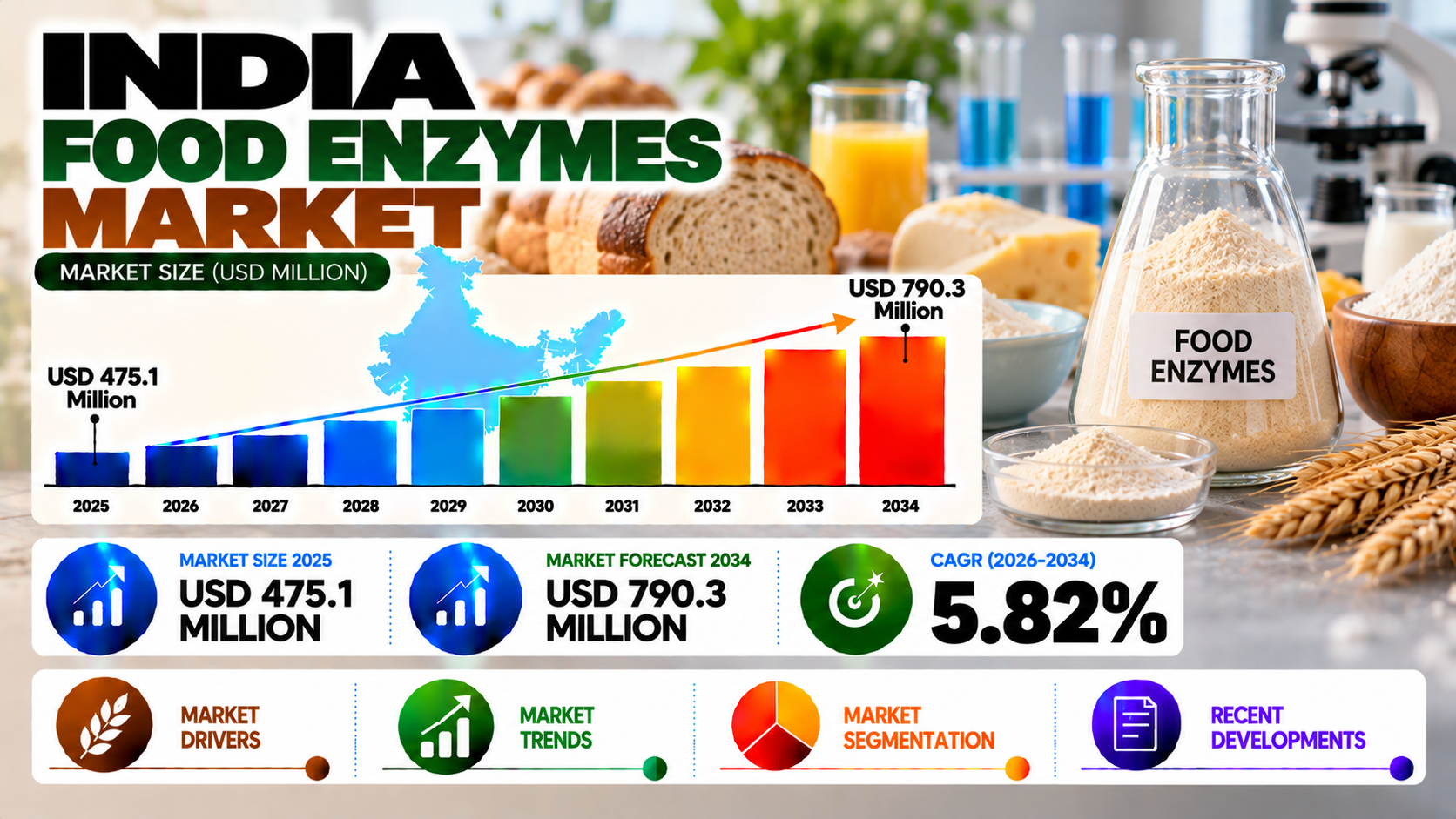
Clean-label demand, growing plant-based food adoption, and advances in microbial fermentation are widening the range of products that rely on enzyme-based solutions. According to IMARC Group, the food enzymes market size in India was USD 475.1 Million in 2025 and is projected to reach USD 790.3 Million by 2034. Supportive food processing programs and updated food safety rules are building a stable base for adoption across dairy, bakery, beverage, and confectionery manufacturing.
Market Snapshot
- Market Size (2025): USD 475.1 Million
- Forecast Market Size (2034): USD 790.3 Million
- CAGR (2026-2034): 5.82%
- Leading Type: Protease (35% share, 2025)
- Leading Source: Microorganisms (60% share, 2025)
- Leading Formulation: Powder (55% share, 2025)
- Leading Application: Processed Foods (32% share, 2025)
- Key Drivers: Food processing expansion, clean-label demand, dairy and bakery growth, government support
Key Market Drivers
- Rapid Expansion of Food Processing Infrastructure:
In 2025, the Ministry of Food Processing Industries approved over 1.44 lakh food processing projects under schemes including PMKSY, PMFME, and PLISFPI, covering 41 Mega Food Parks and 395 cold chain projects. The rise of organized processing units in tier-two and tier-three cities is increasing demand for enzymes that improve efficiency, consistency, and output.
- Rising Appetite for Processed and Convenience Foods:
Urbanization and rising disposable incomes are driving consumption of ready-to-eat meals, packaged snacks, instant noodles, and processed meat. In January 2026, the Indian Economic Survey noted that ultra-processed food sales have risen by 150% over the past 14 years, underlining the scale of this shift and the role enzymes play in texture, flavor, and shelf life.
- Shift Toward Clean-Label and Naturally Derived Ingredients:
Consumers, especially in metropolitan regions, are reading ingredient labels more closely and avoiding artificial preservatives and chemical processing aids. This pushes manufacturers to adopt enzyme solutions that deliver similar functionality while supporting simpler, cleaner ingredient statements.
- Growing Demand Across Dairy, Bakery, and Beverage Sectors:
Dairy accounts for about 25% of India’s overall food and beverage sector, and value-added dairy, premium bakery items, and functional beverages all depend on enzyme-assisted processing for texture, flavor development, and shelf-life extension. Product diversification by manufacturers is increasing the need for application-specific preparations.
Evaluate Market Opportunity with the Business Sample Report
Emerging Trends
- Rising Adoption of Clean-Label Enzyme Solutions:
Novonesis showcased enzyme technologies at Fi India 2025 that help bakers eliminate traditional emulsifiers and improve texture in high-protein, clean-label breads and batters. Enzyme-based reformulation is gaining traction across bakery, dairy, and beverage applications.
- Expansion of Enzymes in Plant-Based Food Processing:
Proteases and carbohydrases are improving the functional properties of plant proteins from soy, pea, and chickpea. In January 2026, 3,20,809 Indians took part in Veganuary, with over 30,000 accessing Hindi-language resources, pointing to growing mainstream interest in plant-based diets.
- Advancements in Microbial Fermentation Technologies:
In February 2026, the PreferCo-Glatt Centre of Excellence for Bioprocess Scale-Up was established in Hyderabad to support microbial precision fermentation and scale laboratory processes into commercial production. These advances enable enzymes with greater substrate specificity, broader pH tolerance, and better activity across temperatures.
- Protein-Focused Product Innovation:
Protein supplements, sports nutrition products, and infant formula require precise protein breakdown, sustaining demand for protease. Improvements in thermal stability and specificity are widening where these enzymes can be used.
Market Challenges
Despite steady growth, the India food enzymes market faces several structural headwinds:
- Specialty and customized enzyme formulations carry high development and production costs, which limits adoption among small and medium-sized processors operating on thin margins
- Many small-scale and unorganized food processors have limited awareness of enzyme benefits and little access to technical application support, slowing penetration beyond larger units
- Evolving rules on labeling, enzyme approvals, and food safety compliance create cost and uncertainty, and standards vary across food categories
- Certain enzyme preparations still require cold chain logistics, adding handling complexity outside the more stable powder formats
Explore the Full Report with Charts, Table of Contents, and List of Figures
Segment Insights
By Type
- Protease (leading at 35%; meat tenderization, dairy protein modification, protein hydrolysis)
- Carbohydrase (amylase, cellulase, lactase, pectinase, and others)
- Lipase
- Others
By Source
- Microorganisms (leading at 60%; scalable, cost-effective, consistent yields through controlled fermentation)
- Bacteria
- Fungi
- Plants
- Animals
By Formulation
- Powder (leading at 55%; long shelf life, storage stability, minimal cold chain needs)
- Liquid
- Others
By Application
- Processed Foods (leading at 32%; ready-to-eat meals, packaged snacks, instant noodles, processed meat)
- Beverages
- Dairy Products
- Bakery Products
- Confectionery Products
- Others
This India food enzymes market analysis shows a clear pattern: leadership in type, source, and formulation reflects a shared priority on reliability, scalability, and easy handling for manufacturers spread across a very large geography.
Regional Insights
- North India: Uttar Pradesh, Punjab, and Haryana; large food processing units, thriving dairy, wheat-based bakery
- West and Central India: Maharashtra and Gujarat; beverage processing, confectionery, modern processing investment
- South India: Tamil Nadu, Karnataka, and Andhra Pradesh; dairy, beverages, rice-based foods, organized processors
- East India: West Bengal, Odisha, and Bihar; emerging region with growing dairy and packaged food consumption
Competitive Landscape
The market is moderately consolidated, with established multinational enzyme producers competing alongside a growing group of domestic players. Food enzyme manufacturers in India are expanding production capacity, setting up localized manufacturing, and building application-specific solutions to strengthen their position.
Partnerships between enzyme producers and food manufacturers are becoming more common as companies co-develop formulations for India’s varied processing needs. Ongoing research, product innovation, and wider distribution and technical support networks across key food processing regions continue to shape competition.
Government Initiatives Supporting the Market
- BioE3 Policy (August 2025): Plans for 16 biomanufacturing hubs aim to reduce dependence on imported bio-based components, including enzymes, and strengthen domestic production.
- FSSAI Regulatory Update (July 2025): Enzymes from genetically modified microorganisms were formally included as permitted processing aids, signaling regulatory acceptance of microbial enzyme use.
- Food Processing Schemes: PMKSY, PMFME, and PLISFPI support processing infrastructure, micro-enterprise formalization, and manufacturing incentives.
- Mega Food Parks and Cold Chain Support: Dedicated clusters and cold chain projects improve supply chain reliability for processors.
Recent Developments
- February 2026: PreferCo-Glatt Centre of Excellence for Bioprocess Scale-Up opened in Hyderabad to scale microbial precision fermentation into commercial production
- January 2026: The Economic Survey highlighted a 150% rise in ultra-processed food sales over 14 years, and 3,20,809 Indians joined Veganuary, reflecting momentum for processed and plant-based foods
- 2025: Novonesis presented enzyme technologies for emulsifier-free, high-protein, clean-label bakery products at Fi India 2025
Investment Opportunities
- High-Growth Product Categories: Protease and powder formulations lead today, while plant-based processing and functional beverages are emerging areas where enzyme use is still deepening.
- Geographic Priority Markets: North India’s processing hubs and West and Central India’s beverage and confectionery base are the strongest anchors, while East India offers early-stage opportunity as cold chain logistics improve.
- Biomanufacturing and Fermentation Technology: Microbial precision fermentation, bioprocess scale-up facilities, and domestic enzyme production capability are priority areas as policy support for biomanufacturing grows.
Request Customized Data Tailored to Your Interest
Frequently Asked Questions (FAQ)
- What is the size of the India food enzymes market?
The India food enzymes market was valued at USD 475.1 Million in 2025.
- What is the projected CAGR?
The market is projected to grow at a CAGR of 5.82% during 2026-2034, reaching USD 790.3 Million by 2034.
- What are the key drivers?
Key drivers include rapid expansion of food processing, rising demand for clean-label and natural ingredients, growth in dairy, bakery, and beverage sectors, and technological progress in enzyme production and formulation.
- What role does government play?
The government supports the market through the BioE3 policy, FSSAI regulatory updates for microbial enzymes, and food processing schemes such as PMKSY, PMFME, and PLISFPI.
- Which segments lead the market?
Protease leads by type at 35%, microorganisms lead by source at 60%, powder leads by formulation at 55%, and processed foods lead by application at 32%.
Conclusion
India’s food enzymes market is on a steady growth path, supported by a growing processing base, shifting consumer preferences, and a policy environment that increasingly favors domestic biomanufacturing. Clean-label reformulation, plant-based food development, and precision fermentation are expanding where enzymes add value.
Companies that invest in application-specific formulations, microbial fermentation capability, and technical support for small and medium processors will be best placed to capture growth through 2034.
Source: IMARC Group